

Purple sapphire engagement rings?
Seriously?
Absolutely.
Sure, it’s not as conventional as the good old-fashioned blue sapphire, but isn’t that what makes them so great in the first place?
Purple is certainly an evocative colour with an aesthetic all its own, and there’s nothing like an engagement ring that uses that perfectly.
A sapphire is a gemstone made from corundum, a crystallised form of aluminium oxide. The purple colour commonly associated with sapphires comes from the concentration of certain minerals within the corundum, such as vanadium.
Like blue sapphires, purple sapphires come in various hues, shades and levels of saturation.
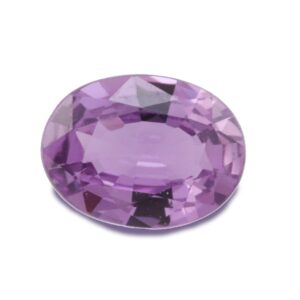
Oval Purple Sapphire
How much does a purple sapphire ring cost?
There are many different factors that influence the cost of a purple sapphire ring, such as:
- The shape of the gemstone (i.e. round, cut, etc.)
- The colour and shade of the gemstone
- Any accompanying gemstones
- The alloy of the band
- Any colour zoning
- Whether the gemstone has received “heat treatment” to bring out its colour
Which country’s purple sapphire is the most valuable?
While purple sapphires are known for their rarity, certain countries still export high quality purple sapphires, such as:
- Myanmar
- Madagascar
- Brazil
- Thailand
How can I tell if my purple sapphire is real?
The easiest way to determine whether or not your blue sapphire is real is to purchase it from a reputable source, such as Holdsworth Bros. Jewellers.
However, if you’re still unsure, there are various methods that can be used to determine whether or not a purple sapphire is real:
- Examination of the gem with a hand lens might reveal some natural looking inclusions that are never present in lab made gems.
- Checking for air bubbles inside of the spinel, as fake spinels tend to be made from glass in which air packets are able to form.
- Its too good to be true. Strong colours in large sizes with cheap prices tend to be a dead give away.
What to look for in a purple sapphire engagement ring
There is a wide variety of shapes and colours available with purple sapphires. Choosing an engagement ring for that special someone should always be based on their personal preferences. The best ring is the one that is meaningful to your partner and matches their sensibilities, not the one that commands a higher price tag. Due to this, you would want to look for rings that showcase a gemstone appropriately, are comfortable to wear, and don’t require constant maintenance.
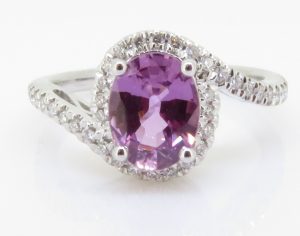
Purple Sapphire Ring
How can you tell a good quality purple sapphire?
The best quality purple sapphires share the following traits:
- Colour that is not too bright, nor too dark. Also, sapphires that feature colour zoning (i.e. the colour fades into transparency instead of filling the entire gemstone) are of a lesser quality.
- Minimal visible inclusions. The less inclusions that are visible to the naked eye, the higher the quality of the gemstone. However, no inclusions at all could be a sign that the gem is fake, so be careful.
- Symmetrical cut sapphires command a higher asking price than asymmetrical gemstones.
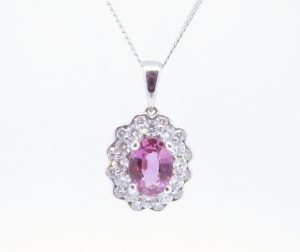
Purple Sapphire Pendant
How to care for a purple sapphire engagement ring
Sapphires require only occasional cleaning and don’t require much maintenance. If the ring is made from silver alloy, you will need warm water and a degreasing cleaning detergent (silver does not react well with detergents). Rinse the ring thoroughly after you scrub it with a soft toothbrush. Avoid using any chemical that contains moisturisers, abrasives, or anti-static agents, as these can leave residue and damage the band at worst.
Are sapphire rings fragile?
Sapphires rank a 9 out of 10 on Mohs scale of hardness, a scale developed by German geologist and mineralogist Friedrich Mohs in 1812. Not only are sapphires extremely durable against abrasions, they are very chemical resistant as well.
How do I style a purple sapphire ring?
At Holdsworth Bros. Jewellers, we’ll help you style your purple sapphire engagement ring however you would like. Our promise is to provide you with the help you need to turn your vision into wearable jewellery that will be cherished for years to come.
Still have questions? Contact us so we can show you the wide range of beautiful blue sapphire engagement rings that we have, and help you find the special ring for that special someone.


