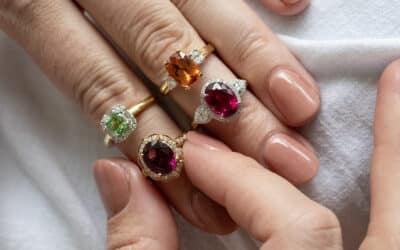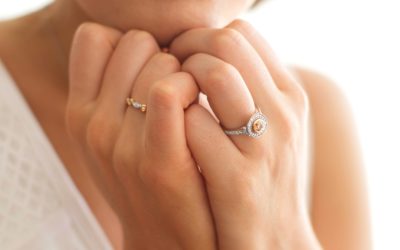
A tourmaline ring is a perfect alternative especially if you’re looking for an engagement ring but diamonds and sapphires just aren’t doing it for you (don’t worry, you’re not the only one).
Tourmaline is a crystalline boron silicate mineral consisting of elements such as aluminium, iron, magnesium, sodium, lithium and potassium.
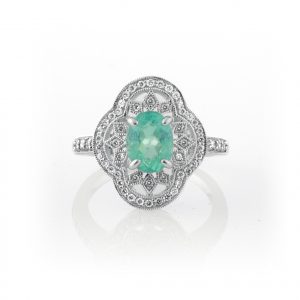
It comes in single-coloured, bi-coloured and tri-coloured varieties, with hues including black, brown, red, orange, yellow, green, blue, violet, pink, etc. The cut of the tourmaline can also affect its appearance. Popular cuts include round brilliant, oval, cushion-cut and emerald-cut. Tourmaline rings can be found in various styles such as solitaire, halo, or vintage designs.
When buying a tourmaline ring, it’s important to choose a reputable jeweller to ensure authenticity and quality craftsmanship. Contact us Holdsworth to speak to a jeweller about tourmaline rings.
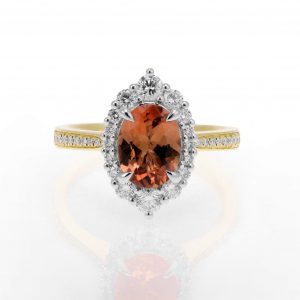
Is a tourmaline ring considered to be a precious gem?
Tourmaline ring is classified a semi-precious stone, aligning it with other gems such as alexandrite, agate, amethyst, aquamarine, garnet, lapis lazuli, moonstone, opal, pearl, peridot, rose quartz, spinel, tanzanite, turquoise and zircon.
It’s worth noting that this distinction does not have scientific backing, and is determined by factors such as rarity. Tourmaline can be found in countries such as Brazil, Nigeria, Zambia, Namibia, Mozambique, Madagascar, Afghanistan, Pakistan, Sri Lanka, Myanmar and China.
How can you tell a good tourmaline?
Contrary to popular belief, colour on its own does not define the value of a tourmaline. In fact, it is several factors that are associated with the colour that determine a tourmaline’s value. These factors include:
- The rarity of certain hues of tourmaline
- The tone of the gem (i.e. you don’t want it to be too dark or too bright)
- The intensity of the colour in the gem
- The incandescence of the gem underneath various light sources
- The number of imperfections such as cracks, pockets of air or liquid, needles, etc.
- The quality of the cut
- Its weight in carats
Does tourmaline fade?
The colour of tourmaline is determined by its chemical structure including transition elements so for this reason the colour is always permanent.
Which stone can be worn with a tourmaline ring?
Because tourmalines come in a wide variety of colours, they pair with all kinds of other gemstones. They can complement sapphires and rubies, or they can have themselves accentuated by more neutral-coloured gems such as diamonds.
Does a tourmaline ring look better with white or yellow gold?
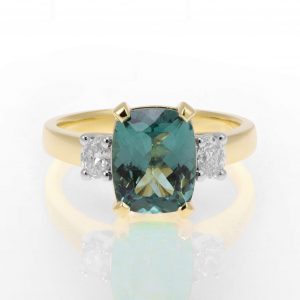
This depends on both the colour of the tourmalines being used for your engagement ring, as well as your intent. Yellow gold creates a striking contrast with tourmalines that have more intense colours, whereas white gold tends to emphasise the individual gems. You should choose the alloy for your band depending on where you want the eye to be drawn the most.
How much are tourmaline rings?
One of the benefits of a tourmaline ring is that there is an engagement ring available to suit any price range. Our most expensive ring prices at $9,995.00, while our least expensive is $895. Our tourmaline rings come with a variety of gemstones and bands, so you won’t have a problem finding the perfect ring for that special someone.
Is tourmaline good for rings?
Tourmaline is a great gem for engagement rings. It is relatively durable, with a wide range of colours and a broad price range. They’re a great option for when you want to tailor your engagement ring without breaking the bank.
What is the rarest color of tourmaline?
The rarest colour of tourmaline is known as the paraiba variety, which contains traces of copper that give it a striking fluorescent hue of neon blue/green. It derives its name from the Brazilian state of Paraiba, where it was first discovered in 1989.
How do you clean tourmaline rings?
The best way to get a tourmaline ring cleaned is to take it to an experienced jeweller who can both inspect it and clean it for you (it is recommended you do this at least twice a year in order to keep your ring in top condition). The second best way is to use warm, sudsy water with either a tightly woven microfiber or a different kind of soft cloth.
Where to buy a tourmaline ring
At Holdsworth Bros. Jewellers, we stock high quality tourmaline rings. Contact us so we can help you find the ideal engagement ring for your perfect proposal.
Tourmaline Ring: Frequently Asked Questions
Can a tourmaline ring be worn every day?
A tourmaline ring is a perfect option to be worn every day. A tourmaline ring is measured at 7.0-7.5 on a hardness scale, making it fairly durable to wear on a daily basis.
Does a tourmaline ring scratch easily?
A tourmaline ring is scratch resistant to most materials under 7 due to ranging between 7.0 – 7.5 on a hardness scale.
Where does tourmaline ring colour come from?
Tourmaline ring colour comes from a variety of elements present in the stone. A tourmaline ring is made out of aluminium, iron, magnesium, sodium, lithium and potassium, which impacts the colour. Aluminium and iron for example, are believed to give a tourmaline ring green and blue hues, whereas magnesium creates more pink and red tone for a tourmaline ring.
Tourmaline ring: what determines the value?
A tourmaline ring’s value is often believed to be determined by colour. However, that’s not necessarily the case. The tourmaline ring’s value is instead determined by the rarity of certain hues and colours within a tourmaline ring. Additionally, the tone and the intensity of the colour, the quality of the cut, carat weight and clarity of a tourmaline ring play a large role in its overall value.
Does a tourmaline ring have any symbolic meaning?
A tourmaline ring is often considered to be a gemstone of enlightenment and resolution. In addition, a tourmaline ring is also believed to reveal the best characteristics and features of those who wear it. The stone is believed to have healing properties and can help with emotional balance and stress relief.
Tourmaline ring care instructions?
The best way to care for your tourmaline ring is to take it to an experienced jeweller who can both inspect it and clean it for you (it is recommended you do this at least twice a year in order to keep your ring in top condition). However, you can also clean with just some warm soapy water and a soft cloth. Avoid wearing or storing your tourmaline ring in areas with direct sunlight and excess heat, as it can impact the colour of your tourmaline ring.
Tourmaline Ring price range
A tourmaline ring is considered to be a perfect alternative to engagement rings as it’s able to suit any price range. At Holdsworth Bros, our most expensive tourmaline ring prices at $9,995.00, while our least expensive tourmaline ring costs $895. Additionally, a tourmaline ring in our collection comes with a variety of different gemstones and bands, so you won’t have a problem finding the perfect tourmaline ring for that special someone.